Showing posts with label EATING AND DRINKING. Show all posts

Monday, July 20, 2009

Vietnamese-Korean Connection: Grilled Pork Belly Lettuce Wraps

Korean pork belly

Last Sunday, I went on a Korean market tour with 3 gal pals – Hyunjoo Albrecht, Linda Lim, and Karen Shinto. You may know Karen, the food stylist who tried to stab me with chopsticks on my Asian Dumpling cookbook photo shoot. Hyunjoo is a Korean food expert and Linda is a lifestyle marketing expert and avid cook and eater.

Korean food is a mystery to me as I’m a little rusty with my Hangul (!!) and most Korean ingredients are labeled in their language full of neat circles and straight lines. There are only a handful of Korean ingredients involved in the cuisines of the Land of the Morning Calm. For example, garlic, soy sauce, sugar, sesame oil, and chiles are the dominant seasonings. Gojuchang is a fermented chile paste that has an addictively smoky, earthy flavor that I’ve enjoyed on numerous occasions in bibimbap rice preparations. However, whenever I’ve gone to a Korean market and had to face with a wall of Korean chile paste tubs, I can’t figure out which to select and blindly choose the highest priced gojuchang. Don’t get me started on cryptic vegetable labeling such as “Korean radish” and “edible leaves.” I’m a mess in a Korean produce section and the banchan side dishes section of a Korean market.

Korean food is up and coming, per the Wall Street Journal and Gourmet in articles this month. For years I’ve been looking for someone to help me demystify the cuisine and recently met Hyunjoo, the person behind Cookingkorean.com. She would be my guide. Linda and Karen were game and the four of us met early Sunday morning in Sunnyvale at Hankook market (1092 E El Camino Real, cross streets are Wolfe and Lawrence Expressway, Sunnyvale, CA 94087).

Korean market tour Vietnamese-Korean Culinary Linkages
If you’ve hung around enough Korean American communities, you’ll notice that there are a number of unusual Vietnamese-Korean culinary connections. It basically winds down to pho noodle soup. Koreans love the soup and I’ve enjoyed a decent bowl in Los Angeles Koreatown on Western Avenue. At a Korean-owned pho shop, you can get a side order of kimchi and the bowls are relatively big, reflecting the Korean penchant for large quantities of food. On the flip side, a small number of Vietnamese pho shops have taken to serving their noodle soup in fancy Korean metal bowls, which keep the soup tongue-scalding hot.

Koreans use fish sauce to make kimchi as the condiment lends a nice briny, savory undercurrent. Vietnamese people have made kimchi for decades. It’s not a big thing but my mother has a hand-written recipe dating back to the 1970s. Oh, and beef is well loved in both Korea and Vietnam. Beef is not a popular meat in other Asian cuisines. And since we were exchanging culinary expertise last Sunday, Hyunjoo asked me if I knew anything about rice paper as Koreans are using more of it these days to wrap food up in. Ahem… banh trang? Yes, I happen to be familiar with it. (That's Hyunjoo in the photo, talking about virgin vs. married man radish. It's all about the shape, my friends.)

But was there something more? I wondered and about 1 hour into the market tour and we’d made it out of the Korean banchan section of the market into produce, I had an inkling. There was all this lettuce and lots of large serrated beefsteak (sesame) leaves, a relative of Japanese shiso that looked a lot like Vietnamese tia to and kinh gioi. “Koreans love beefsteak leaves with grilled meat,” Hyunjoo said. “We like to wrap the meat and herbs up in lettuce with chile paste and raw garlic. Some people add thin slices of Korean radish too.”

Korean radish

Above is a small Korean radish, called "mu." It's denser than
daikon and sweet tasting with a crisp, refreshing flavor.

Well, doesn’t that sound like how Vietnamese people many kinds of grilled and fried morsels? This particular Korean foodway was very similar to that of Vietnam, and it wasn’t a new and recent adaptation. Viets love to create bundles with lettuce. In fact, we like to create lettuce wrap bundles with many foods, not just grilled meats like the Koreans do.

Speaking of which, in the meat section there was tons of beautifully sliced beef and pork to be used in soup and for Korean barbecue. Hyunjoo zeroed in on a particular sale item – black pork belly on sale for $3.69 a pound, sliced 1/4 inch thick. Her eyes practically glazed over as she cooed, “Oh I love grilled pork belly.” The pork was well trimmed (not too much fat) and the skin had been removed. It was a beautiful site to behold.

Sliced pork belly

The black pork belly from Hankook market. The large rectangular
cutting board came from the market too. A great deal for $13.99!

Black pork stands for meat from black Berkshire pigs. The flesh is extraordinarily flavorful and succulent. My mama didn’t raise no dummy so I picked up some.

Then I asked Hyunjoo about the gojuchang chile paste – my enduring problem. “Oh, get this one with the hexagon symbol. They’ve been around for 60 years and it’s good,” she said. “Don’t get the one with the funny looking kid.” Right. Turns out the 60-year-old one is made by Siempo, a well-trusted Korean manufacturer also know for good soy sauce. I brought home a ‘small’ tub that weighed 1 kilo. There are Costco-size tubs too.

Gojuchang

Look for the hexagonal symbol to find Siempo brand of gojuchang.

You perhaps can see where I was going with the pork belly and chile paste. The winter-into-spring weather has turned practically balmy in Northern California and I was looking for an excuse to turn on the grill. Plus, our locally grown lettuce is amazing these days given the mild winter we’ve had.

In tribute to the Korean market foray, I marinated the pork belly in a garlicky Vietnamese-Korean combo of flavors, grilled the meat (it’s like thick fresh bacon), and set out a platter of lettuce, herbs, chile paste and nuoc cham dipping sauce. Rory and I made lettuce wraps and drank a hefty amount of chilled Korean soju (a little heavier than sake but nice and smooth). A divine cross-cultural meal to end the day of cross-cultural learning.

RECIPE

Grilled Pork Belly Lettuce Wraps

These kinds of lettuce wraps are called ssam in Korean, and if you’re in the New York area, you may be familiar with them, given all the hubbub surrounding David Chang’s Momofuku Ssam bar. Well, it’s a drinking kind of meal of well-seasoned grilled meat accompanied by raw garnishes including lettuce, thinly sliced garlic, gojuchang chile paste and perhaps some kimchi and thin slices of Korean radish. You could include cooked medium-grain rice too.

The Viet version would have a fish sauce based nuoc cham spiked by fresh chile and garlic, tons of fresh herbs, thinly sliced cucumber and some cooked rice noodles (bun). For this Vietnamese-Korean mash up, I marinated the pork with a typical Viet set of seasonings (shallot, sugar, fish sauce and black pepper) and then added a dose of Korean-ess in the form of extra garlic, sesame oil and finely chopped scallion; Korean cooks often use a fruit tenderizer such as grated Asian pear but the shallot takes care of that. Condiment wise, it was hard to choose and I went with both nuoc cham and gojuchang. No noodles, rice, nor rice paper to keep things low carb and less fuss. Really delicious. So get yourself to a Korean market for some sliced pork belly and get cooking.

Serves 4 as a light main course

Marinade
1 shallot, chopped (1/4 cup)
3 large cloves garlic, chopped
1 teaspoon finely chopped ginger
2 1/2 tablespoons light brown sugar
1/2 teaspoon black pepper, freshly ground preferred
4 teaspoons fish sauce
1 1/2 teaspoons dark (thick) soy sauce
1 tablespoon sesame oil
2 scallions (white and green parts) finely chopped

1 1/2 to 1 3/4 pounds 1/4-inch-thick sliced pork belly
Leaves from 2 heads lettuce (red leaf, green leaf, or butterleaf)
Assorted fresh herbs, such as cilantro, mint, red perilla (tia to), and/or Vietnamese balm (kinh gioi) (details on Vietnamese herbs)
1/2 pound peeled Korean radish or cucumber, thinly sliced
20 beefsteak (sesame) leaves (optional)
3 cloves garlic, thinly sliced (optional)
1 cup kimchi (optional)

Condiments (choose one or both):
3/4 cup nuoc cham dipping sauce
1/4 cup Korean gojuchang red chile paste (see photo above of recommended brand)

1. Put the shallot, garlic, ginger, and sugar in a mortar and pestle and pound to a rough paste. Add the black pepper, fish sauce, soy sauce, sesame oil, and scallion. Taste and adjust the flavors to your liking. I like a garlicky savory over a sweet savory flavor. Add seasonings and get it to your liking before you add the pork.

2. Mix the pork with the marinade with your hands to ensure that every slice is well coated. Cover with plastic wrap and refrigerate for at least 4 hours and as long as 2 days.

3. About 45 minutes before grilling, remove the pork from the refrigerator and set it out at room temperature to get rid of some of the chill. Put the lettuce, herbs, radish, sesame leaves, and garlic onto a platter and small side dishes and set at the table. Put the condiments at the table too.

4. Preheat the grill to hot and then grill the pork, about 6 minutes, turning as needed, until cooked and nicely charred. Bring to the table. Set out scissors for every to cut the meat (makes it easier to eat).

5. To eat, put a palm-sized piece of lettuce in your hand, add herbs and other fresh garnishes, a smear of chile paste (if using) and the meat. Bundle it up and eat. If eating with nuoc cham, bundle up the lettuce leaf wrap and dip in the sauce.

According to vietworldkitchen.com

Recipes: Meat

Banh_hoi-rasa-malaysia

Banh Hoi with Grilled Beef Recipe

I was prompted by a few recent emails asking about Vietnamese banh hoi fine rice noodles. For example, Perry in Seattle wanted to recreated a version of banh hoi from San Francisco's Slanted Door restaurant. Bee Yin Low of the lovely Rasa Malaysia site told me that the noodles are among her favorite Vietnamese foods. The other day, I responded to people's request for more information on banh hoi with the general low-down in Vietnamese Noodles 101: Banh Hoi Fine Rice Noodles.

And today, I've guest posted a recipe for banh hoi with grilled beef on the Rasa Malaysia site. The photo above is to whet your appetite. For the recipe, you'll have to visit Bee's site. Check it out and start noodling around with banh hoi.


Vietnamese Restaurant-Style Grilled Lemongrass Pork (Thit Heo Nuong Xa)

Grilled pork with lemongrass


We flew Jetblue back from New York City on Sunday and when we stepped out onto the tarmack at San Jose airport (you have to do that at San Jose’s terminal C), it was 10pm, humid and hot. The pilot had announced that it was about 75F. I’m always thinking about my next meal and said to Rory, “It feels like a nice evening in Southeast Asia. Let’s grill something tomorrow with lots of garlic and fish sauce.”

Though I went to New York to teach cooking class and for business meetings, we had plenty of time to eat out with friends. The Shanghai soup dumplings were delightful, and so was the Greek food at Snack Taverna, Tuscan fare at Bar Pitti, old-fashioned Italian at Felidia, high-end homey Japanese at Aburiya Kinosuke, Belgian fries at Resto, ramen at Momofuku Noodle Bar, and modern American at Craft Bar and Gramercy Tavern. We even left Manhattan for exceptional food at Cucharamama in Hoboken and a spritely lunch at Marlow and Sons in Brooklyn. (If you’re wondering, we walked a lot and the fifth-floor walk up that we rented enabled us to fend off any weight gain.) But at the end of the week, I hankered for home cooked food. In fact, whenever I return from a trip, I look forward to cooking my own food.

With our current California heat wave, I decided to grill pork steaks – pork shoulder steaks to be exact as they’re much more flavorful and fattier than the typical thin, dry loin chop used for Vietnamese grilled pork. Someone recently requested that I post a recipe for the grilled pork that Vietnamese restaurants often prepare and serve with rice plates and the like. I have a running list of recipe requests but moved that one up to the top of my priority list. Maybe it’s because I was trying to bridge eating out for a week with cooking at home? Or was the weather dictating my cooking? Probably a bit of each so I set to the kitchen yesterday afternoon.

Replicating Vietnamese Restaurant Food
Restaurant food is not the same as home cooking. Restaurant food is generally a lot sweeter and saltier than homemade food. The reason? The bolder flavors get customers to drink and eat more; it’s a Pavlovian thing. People also love to indulge in big flavors when they go out, so it’s a push and pull dynamic with restaurant dining.

With regard to Vietnamese restaurant cooking, there’s usually a smidgen of MSG added to food for good measure. I don’t use MSG (real or fake MSG), but I decided to go heavy on the seasonings in this pork marinade. Also, as mentioned above, I used succulent pork shoulder instead of dryish pork chop – which most Vietnamese restaurants use to my dismay. And, I grilled the pork over an open flame for nice charring and flavor. Lost of Vietnamese restaurants broil and the flavor is rather flat. Soy sauce adds color here, and if you use dark (black/thick) soy sauce (called hac xi dau in Vietnamese), the meat will take on a mahogany cast.

As I sliced the juicy fragrant pork, we had to sample a few pieces to ensure doneness. Rory looked at me and said, “No matter where we eat, the best food is at home.”

RECIPE

Vietnamese Restaurant-Style Grilled Lemongrass Pork
Thit Heo Nuong Xa

You can use this marinade with small pieces of pork and thread them on skewers and dip them in some nuoc cham dipping sauce. If there’s no lemongrass, use about 1/2 teaspoon Chinese five-spice powder instead. Slicing the pork at the end is a traditional Vietnamese approach to eating meat as the pieces are easier to pick up with chopsticks. Enjoy with rice, a stir-fried or grilled vegetable and a quick soup (canh). Feel free to stuff leftovers into banh mi sandwiches and use them for bun rice noodle salad bolws.

Serves 4

1 pound boneless pork shoulder steak, about 1/2 inch thick

Marinade:
11/2 to 2 tablespoons granulated or light brown sugar
1 tablespoon chopped garlic
1 tablespoon chopped shallot or yellow onion
1 stalk lemongrass, trimmed and finely chopped (3 tablespoons)
1/4 teaspoon black pepper
1 1/2 teaspoon dark (black) soy sauce
1 1/2 tablespoon fish sauce
1 tablespoon oil

1. Cut the pork shoulder steak into pieces about 3 to 4 inches big. Set aside.

2. Put the sugar, garlic, shallot and lemongrass into an electric mini chopper and process to a fine texture. (Or, mince the garlic, shallot, and lemongrass individually, put them into a bowl, and add the sugar.) Add the pepper, soy sauce, fish sauce, and oil and process to combine well. Aim for a relatively smooth texture. The marinade will be chocolate brown. Transfer to a bowl.

3. Add the pork, and turn to coat well. Cover and set aside at room temperature to marinate for 1 hour. Or, refrigerate up to 24 hours, letting the meat sit out at room temperature for 45 minutes to remove some of the chill before grilling.

4. Preheat a grill to medium-high. Grill for 6 to 8 minutes, turning frequently, until cooked through. Nick with a knife to test. Transfer to a plate, loosely cover with foil or an inverted bowl for 10 minutes before slicing and serving.

According to vietworldkitchen.com
Sunday, July 19, 2009

EATING AND DRINKING IN HANOI

Hanoi

CHINESE/ASIAN

First Restaurant
12 Trang Thi Tel 824.0060
Good foood relaxed setting

Genghis Khan
E3 Nui Truc, Tel: 846-1567
Mongolian barbecue

Halal Restaurant
Heritege Hotel, 80 Giang Vo,Tel: 8344727
The only genuine halal restaurant in town

Mother’s Pride
6C Phan Chu Trinh, Tel: 826-2168
Classic Singaporean cuisine

Somerset West Lake
2540 Thuy Khue, Tel: 843.0030
Singaporean cuisine

Sinh Chau
75 Ly Thuong Kiet, Tel: 826-6629
Fresh seafood at reasonable prices


Thien Quan Restaurant
Thien Quang Lake, Tel: 826-7353
Floating restaurant

JAPANESE
Akontobo
V Tower, 649 Kim Ma, Tel: 766-4604
Just opened Special romen noodle soup

Ky Y
29 Phu Dong Thien Vuong, Tel: 978-1386
Healthy food , reasonable prices

Nihonbashi
142B Nguyen Chi Thanh, Tel: 835-2643
Traditional food, reasonable prices

Ohan
322 Ba Trieu, Tel: 821-6033
Choice of some 300 dishes

Saigon Sakura
17 Trang Thi, Tel: 825-7565
Vietnamese-run, authentic cuisine

SEAFOOD
Cha Ca La Vong
14 Cha Ca, Tel: 825-3929
Northern specialities, tourist favourite


Pho Bien
14 Trang Thi, Tel: 828-9954
Fresh Vietnamese style seafood

San Ho
58 Ly Thuong Kiet, Tel: 822-2184
Luxurious setting, fine seafood

Sam Son Seafood Market
77 Doc Bac Co. Tel: 825.0780
Giant seafood market, inexpensive

Ngoc Suong
29 Phu Doan, Tel. 828-5236, 824-3720
82 Hoa Ma, Tel: 826-3664, 611.0746
Excellent seafood, keen prices

INDIAN
Khazana
24 Hang Be, Tel: 824-5359
Great curries, good vegetarian selection

SANDWICHES/SNACKS
Fanny’s Ice Cream
48 LeThai To, Tel: 828-5656
French ice cream and sorbet

L’s Place
Van Phuc Compound, Tel: 846-1883
Serves food, next door to a great minimart

Koto Sandwiches
27 Quoc Tu Giam, Tel: 732-1 105
Build your own gourmet sandwich
Run by and in aid of street kids

Noodles
24 Nguyen Sieu, Tel: 828-6861
Excellent sandwiches

The Deli
138 Hai Ba Trung, Tel: 934-2335
Freshly prepared delicacies, sandwiches

The Delicacy
10F DinhLiet, Tel: 934-3238
Sandwiches and pizza

THAI
Baan Thai
3B Cha Ca, Tel:828-1120
Authentic Thai cuisine at reasonable price

Bangkok - Hanoi
52A Ly Thuong Kiet, Tel: 934-5598
Popular with expats

Hong Thoong
12 Nguyen Du, Tel: 943-1428
Special Thai food, good prices

Siam Corner
Oriental Pork, Quang An, Tel: 829-1200
Authentic Thai dining

VEGETARIAN
Com Chay Nang Tam
79A Tran Hung Dao, Tel: 826-6140
Highly recommended

Thanh Tam
204 Pho Cuc Chinh, Tel: 828-1252
Typical Vietnamese vegetarian food

CZECH

Hoa Vien
8 Doc Ngoc Ha, Tel: 733-0333
Czech food and beer

Fast Food
Pumpkin Café
105 – K1, Giang Vo, Tel: 856-0005
Set lunch and dinner

Restaurant 123
55 Pho Hue, Tel: 822-9100
Inxepensive. Very popular with locals

French
Café des Arts de Hanoi
11B Bao Khanh lane, Tel: 828-7202
Traditional French cuisine

Café de Paris
10 Tong Duy Tan, Tel: 928-5227
Re-opened: some of the best deals in town

Cyclo Bar, Restaurant and Garden
38 Duong Thanh, Tel: 828-6844
French and Vietnamese cuisine

Gustave Restaurant Francais
17 Trang Tien, Tel: 825.0625
Classic French dining

ITALIAN
A Little Italian
78 Tho Nhuom
Hotline for free delivery 825-8167. Great pizza and pasta

Al Logo
5 Xuan Dieu, Tel: 718-4027
Italian chef and cuisine

II Grillo
116 Ba Trieu, Tel: 822-7720
Classic Italian menu, intimate atmosphere

II Padrino
42 Ly Thai To, Tel: 828-8449
New and traditional Italian cuisine

La Primavera Ristorante Romano
12 Hue, Tel: 8283202, Fax: 822-5949
Italian and Vietnamese dishes

La Terrazzo
107 A5 Giang Vo, Tel:846.0155
125 Trieu Viet Vuong, Tel: 978.0622
Italian specialities and some of the best pizza in town

Mediterraneo
23 Nha Tho, Tel: 826-6288
Pizza and traditional Italian food

Pepperonis
29 Ly Quoc Su, Tel: 928-5246
Great value pizza and pasta, monthly Specials

KOREAN
La Hoa Korean Restaurant
5 Quoc Tu Giam, Tel: 826-7215
Traditional Korean restaurant and hotel

Seo Ha
8 Ngoc Khanh, Tel: 821-6033
Traditional menu, decint shabu dhabu

Seorabyul
C6 Giang Vo, Tel: 846-2626
Bulgogi and seafood

VIETNAMESE
Cay Cau
17A Tran Hung Dao, Tel: 824-5346
Cosy decor and first-class service

Club Opera
59 Ly Thai To, Tel: 824-6950
Excellent food, great setting

Com Duc Vien
13 Ngo Thi Nham, Tel: 943.0081
Interesting, varied menu

Com Nieu Que Huong
250 Ton Duc Thang, Tel: 851-7140
Great food in a classic setting

Hanoi Garden
36 Hang Manh, Tel: 824-3402
Traditional southern Vietnamese cuisine

Indochine
16 Nam Ngu, Tel: 824-6097
Elegant Vietnamese dining

Little Hanoi
25 Ta Hien, Tel:926.0168
Traditional Vietnamese food

Nam Phuong
19 Phan Chu Trinh, Tel. 824.0926
Southern cuisine; traditional music performed nightly

Phu Dong Thien Vuong
47 Tran Xuan Soan, Tel: 943.0305
Vietnamese specialities. Inexpensive

Seasons of Hanoi
958 Quan Thanh, Tel: 843-5444
Colonial setting

Soho
57 Ba Trieu, Tel: 826-6555
Great regional cuisine in on airy villa
Set menu available

The Delicacy
1OF Dinh Liet, Tel: 934-3238
Traditional Vietnamese food

DRINKING

Apocalypse
5C Hoa Mai, Tel: 971-2783
Favourist expat and tourist rightclub

Brother's Cafe
26 Nguyen Thai Hoc, Tel: 733-3866
Set in an old temple. Good food

Cafe Lac Viet
46 Ly Thai To, Tel: 828-7207
Coffe and a light , healthy menu
Films sunday, Monday and Thursday

Cafe Pho
15 Ly Thuong Kiet, Tel: 826-6862
Quiet villa setting. Serves food

Diva Cafe
57 Ly Thai to, Tel: 934-4088
Local fovourist, fine decor

Relax Bar
60 Ly Thuong Kiet, Tel: 824-8409
There's fun, there's the view and much more

R & D Lounge
19 Pham Dinh Ho, Tel: 971-3888
Happy hour 5.30- 7.30pm. Live music

Dak-linh Cafe
Hoan Kiem Lake, Tel: 828-7043
Great lakeside location

Dak-linh Cafe
Hoan Kiem Lake, Tel: 828-7043
Great lakeside location

Green Cafe
24-26 Hang Hanh, Tel: 828-7863
Drinks, fast food and darts

Kinh Do
252 Hang Bong, Tel : 825-0216
Good Food, inexpensive

Jazz Club
31 Luong Van Can, Tel: 828-7890
Third time lucky for local fazz guru
Quyen Van Minh

Lido Night Club
46 Hang Cat, Tel: 825-7773
Karaoke and dancing

Little Hanoi
21 Hang Gai, Tel: 928-5333
Cold beer, games and TV

Long Vien Bar & Cafe
42 Hang Bun, Tel: 843-8117
Food, live musc, karoke and billards

Moca Cafe
14-16 Nha Tho, Tel: 825-6334
Coffe roasted on site. International cuisine

New Century
10 Trang Thi, Tel: 928-5285
The newest nightclub in town

Eating and drinking in Vietnam

Eating:

Within tourist areas, a wide range of food acceptable to the international palate is freely available, restaurants are usually clean and menus often have English translations. Elsewhere, the variety is far less, dishes and menus are often unrecognisable and preparation and eating areas are a long way from international standards of hygiene. Having said that, few visitors seem suffer food-related illnesses during their stay!

Apart from the most expensive establishments, hotel food is nearly always offered as a buffet with a mixture of Asian and international dishes. Although the quality may be good, the variety is often unimaginative. Haivenu usually leaves you to your own devices in the evening so that you can choose the type of food and level of restaurant that you prefer. We also offer an 'eat street' alternative in Hanoi, whereby you can sample the bewildering array of specialist street 'cafés'. Our staff will be pleased to accompany you to the places where the locals eat - the food will be wholly authentic, delicious and cost a fraction of restaurant prices. Don't expect Western-style 'hygiene' though - however, we've taken plenty of our guests to 'eat street' without a single stomach uset! On tours including meals, we use the best available restaurants. In remote areas without suitable restaurants, picnic meals will be provided.

Vietnamese food is mostly nutritious and healthy. Cooking methods are confined to grilling, frying, boiling and steaming, as ovens are not used. The staple is rice, either as grain or flour. The cuisine varies according to the region. In the north, it is comparatively bland, with a strong Chinese influence. Food in the Hue area is spicier, with some French touches. In the south, dishes with hot spices proliferate. Each area has its own local specialities.

Drinking:

Vietnam has wide range of soft drinks, ranging from ‘Coke’ and ‘Pepsi’ produced here under licence to locally produced fizzy drinks and ‘energy-boosting’ concoctions. Fruit juices are ubiquitous, ‘nuoc trang’ (water, lemon juice and sugar) being very popular. Fresh orange juice and other sweet fruits are sometimes served with added sugar or salt – watch the person making it and stop them if necessary. Also very popular with visitors are fruit ‘shakes’: chopped fruit blended with ice, water and milk in a blender.

Vietnamese coffee is mostly grown in the Central Highlands. Robusta is the usual variety served in Vietnamese establishments – black, thick, and very strong. The minority of Vietnamese people who drink coffee usually mix it with condensed milk – definitely an acquired taste for most foreign visitors. In the cities, smoother Arabica coffee and fresh milk is becoming popular. A curious, and expensive, variety is ‘Weasel Coffee’: Arabica beans are fed to a weasel, pass though the animal’s digestive system, excreted whole, and then collected. Its passage through the creature’s intestines is supposed to create a more mellow flavour. For Vietnamese coffee cafés look for the sign 'Trung Nguyen' - they are very common throughout Vietnam. For Western-style coffee, visit the tourist areas.

Vietnamese tea is mainly green, sometimes with flavourings, and drunk without milk or sugar from small handle-less cups. This is the drink traditionally offered to people visiting families, friends, offices, shops and so on. Black tea is also popular, but drunk without milk. If you want a traditional cup of tea with milk, stick to the tourist areas - elsewhere you're likely to end up with lukewarm water with a teabag and condensed milk.

The range of alcoholic drinks in Vietnam is limited. Apart from expensive imported wines and spirits, most drinks available are domestically produced variations on rice wine, or lager-type beer. Rice wine is drunk neat, often direct from the fermentation jar via a bamboo straw, or distilled into a spirit, usually mis-labelled ‘vodka’. The wine is also used as a base for the addition of plants, barks or animals. These are usually drunk for their ‘medicinal’ purposes – snake wine is very popular with men who believe it enhances virility.

In the north, 'medicinal' wines and spirits can sometimes be found - definitely worth a tasting session. In Hanoi, there is a restaurant that specialises in fruit wines and liqueurs from the hill tribe villages - our staff will be pleased to escort you and help you to return to your hotel.

Beer comes as variations of French-style lager, and as ‘bia hoi’. Also known as 'fresh beer, it is relatively low in alcohol, produced daily, and served ice-cold. It’s cheap, ubiquitous and delicious on a hot day!

According to vietnam-holidays.co.uk

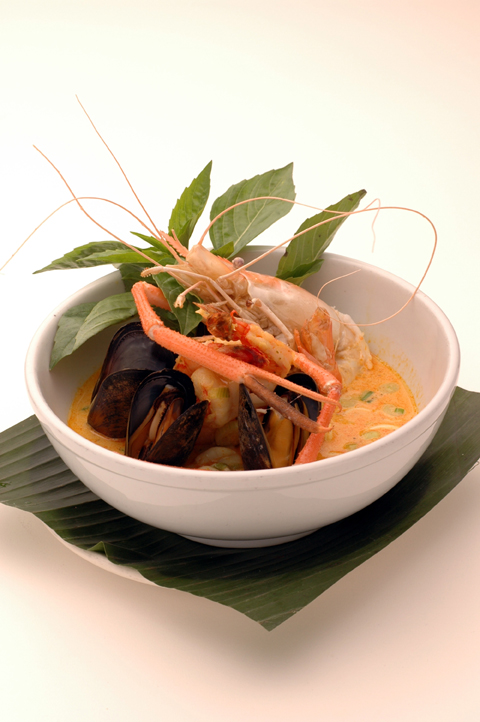
Indochine's Vietnamese Bouillabaisse

Indochine Vietnamese Bouillabaisse.jpgIngredients:
Seafood

2 dozen freshly cleaned mussels
12 shelled & deveined large prawns
1 cup calamari rings
½ lb medium scallops

Vegetables
2 cups finely shredded Chinese cabbage
½ cup fried minced shallots
4 sprigs Asian basil (for garnish)
4 lime wedges (optional)

Broth
4 cups fish broth (chicken broth can be substituted)
2 cups coconut milk
2 tablespoons finely shredded kaffir lime leaves
½ tablespoon shrimp paste
2 tablespoons garlic chili paste (more or less to taste)
½ tablespoon curry powder (or paste)
5 tablespoons undiluted Vietnamese fish sauce
4 tablespoons tomato paste
1 tablespoon sugar

Procedure:

Bring the broth, coconut milk, shrimp paste, chili paste, fish sauce, tomato paste and sugar to a boil; reduce heat; add the curry powder and lime leaves; simmer at medium heat for 10 minutes. Taste and adjust seasoning if necessary.

Add the mussels and let simmer for 2 or 3 minutes. Add the rest of the seafood and simmer at low heat for 2 minutes (don’t overcook or else the seafood will get tough and rubbery).

Divide the shredded cabbage in 4 fairly large bowls. Divide the seafood in the four bowls and pour the broth on top. Garnish with a sprig of basil and sprinkle fried shallots on top. Garnish with lime wedges.


Address: 430 Lafayette St., nr. Astor Place
According to estaurantgirl.com